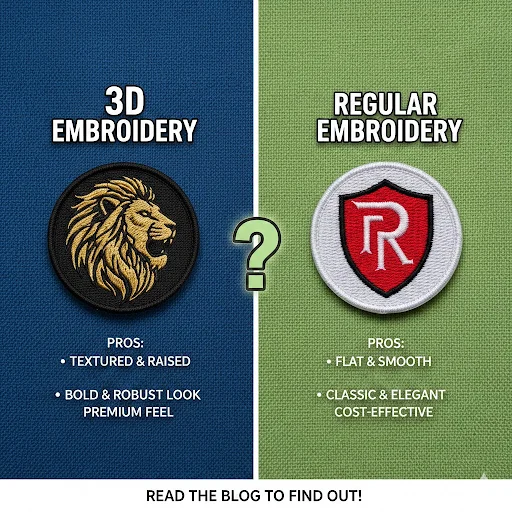
If you are ordering patches, the “embroidery” choice sounds simple until you see the proof and realise the look can swing wildly. One option sits flat and classic. The other one pops with height and attitude. That’s the whole game in 3D Embroidery vs Regular Embroidery.
Want the full “what it is, how it’s made, where it works” breakdown for 3D, read this first: What Are 3D Embroidered Patches – A Practical Guide for Brands.
Let’s jump in.
The Quick Difference You Can Feel
- Regular embroidery is stitched thread that sits mostly flat. It has texture, but it’s not trying to stand tall.
- 3D embroidery (often called puff) is raised embroidery. It uses foam under stitches to create height, so the logo looks thicker and bolder.
Here’s the honest truth people do not want to hear: the “best” choice depends on your logo and placement. That said, if you want a vendor that helps you pick correctly instead of just taking your money, that’s what people mean when they say best patch maker.
Look and Vibe: Classic vs Loud
Regular embroidery look
Regular embroidery gives you that uniform-ready, heritage feel. It’s the safe pick for:
- Work shirts and jackets
- Club patches
- Scout and team emblems
- Anything that needs to look official, not trendy
It also handles mixed designs better. If your logo has outlines, small shapes, or multiple elements, regular embroidery has more room to behave.
3D embroidery look
3D embroidery is bolder on purpose. The raised areas catch light and shadow, which makes the logo look bigger even when the patch size is the same.
It’s a strong fit for:
- Hat fronts, snapbacks, trucker hats
- Big initials, block lettering, simple icons
- Streetwear and merch that wants that “pop” effect
If your logo is simple, 3D can make it look expensive fast. If your logo is detailed, 3D can make it look messy fast.
Detail and Readability: Where Most Orders Go Wrong
This is the part that saves you from a re-order.
Regular embroidery handles detail better
Regular embroidery can still struggle with super tiny text, but it’s far more forgiving than 3D. If your design has:
- Small lettering
- Thin strokes
- Detailed shapes inside shapes
Regular embroidery is usually the smarter call.
3D embroidery needs bold shapes
3D puff needs space. The raised stitches are thicker, so fine details get swallowed. If you try to puff tiny text, you often get:
- Filled-in letters
- Rounded corners that should be sharp
- Blurry edges on small elements
If you are set on 3D but your logo has detail, do a hybrid. Puff the big letters. Keep outlines and small text flat. That’s the “clean and premium” build most brands should use.
Placement: Where Each One Actually Wins
Hats
Hats are where 3D shines, especially structured caps. The raised look fits the shape of a hat and reads from a distance. Regular embroidery works too, but 3D usually looks bolder for the same design.
Uniforms and daily-wear gear
If it’s getting washed constantly and worn hard, regular embroidery is the dependable choice. 3D can still work, but you should be realistic about friction and long-term wear if the raised areas get rubbed a lot.
Jackets and heavy outerwear
Both work. 3D looks great on heavier garments. Regular embroidery stays clean and is easier to keep readable if the logo is complex.
Cost and Production Reality: What Moves the Price
Price usually shifts based on:
- Stitch count and complexity
- Patch size
- Whether the design requires special digitising for puff
- How much of the design is raised vs flat
3D can cost more because it needs puff-friendly digitising and often higher stitch coverage in the raised areas. Regular embroidery can also get expensive if you pack a ton of detail into a large patch. Either way, complexity is what gets you.
Durability: Which One Holds Up Better
Both can be durable when produced well, but they fail in different ways.
- Regular embroidery tends to age evenly. If it wears, it looks like normal wear.
- 3D embroidery can show damage faster on the raised edges if it is constantly rubbing against surfaces.
If your patches are going on rough-use gear, it’s worth comparing other types too. The patch breakdown guide covers that angle without forcing you into embroidery by default.
Choosing the Right One in 30 Seconds
Use this quick filter:
Pick regular embroidery if:
- Your logo has small text or thin lines
- You need a classic uniform look
- You want the safest option across different garments
Pick 3D embroidery if:
- Your logo is bold and simple
- The patch is going on hats or heavy garments
- You want raised lettering that grabs attention
Pick a hybrid build if:
- You want the 3D pop but still need readable details
- Your logo has one strong element plus smaller supporting text
If you’re ordering premium 3D custom embroidery patches in USA and you care about repeatability, the hybrid approach is what keeps brands from bouncing between “looks amazing” and “why does this batch feel off?”
Frequently Asked Questions
Your Patch Deserves the Right Build!
If your artwork is bold and you want it to stand out, go 3D. If your logo is detailed and you need it readable, go regular. If you want both, go hybrid and stop forcing one style to do every job.
Want this sorted fast? Share your logo, patch size, placement, and quantity. We’ll tell you straight which option will look clean, then get a proof ready so you can move forward without guessing.
If you’re looking for the best patch maker experience, this is it: clear recommendation, clean proof, and a patch that shows up the way you expected.